


Laptop – An Intimate Instrument
Mar 20, 2026
Related Links
Laptop – An Intimate Instrument
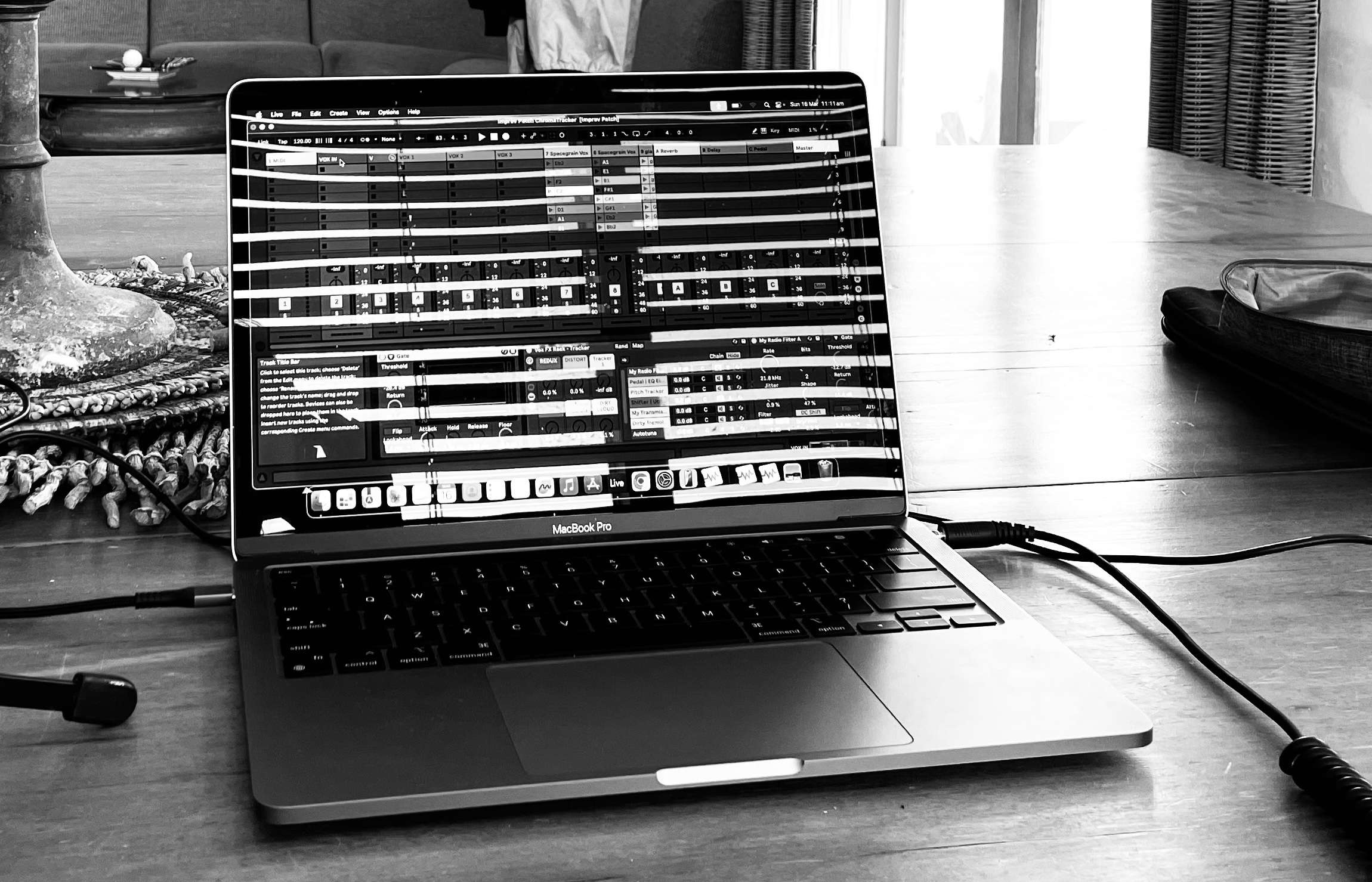
Holly Herndon in her chapter for ‘Audio Culture’ describes the laptop as the ‘most intimate instrument’.
‘I quickly realized that the laptop is the most intimate instrument the world has ever seen. It mediates all aspects of our lives, connecting with the good and the bad of the world around us. We do our banking on this instrument and use it to connect to our friends and family. Our employer interrupts us as we make art through this instrument. Our view of the world changes in accordance with how we customize it.’(1)
The rise of the laptop and its portable recording software have transformed the way we compose music. This has led to a democratisation of music production, with access to highly professional production tools available to a diverse cross section of society. Our attitudes towards creativity and composition are often rooted in romantic ideals which are being slowly superseded. The composer is now just as likely to create while sitting in bed with a laptop as at the piano scribbling passionately on sheets of manuscript paper. We experience the historic tipping point in which the distance between technology and ourselves rapidly decreases (2).
The development of home production software – the DAW (Digital Audio Workstation) transformed the music world. It can be seen as a ‘disruptive technology’, one that ‘underperforms established products in mainstream markets... (but has) other features that a few fringe (and generally new) customers value’. They are ‘typically cheaper, simpler, smaller and... more convenient to use (3). The DAW brought the contents of a professional studio to the private setting, for a relatively low cost, making music production work a possibility for amateurs as well as professionals (4). People who may have been previously excluded from working in this field have been enabled through this greater accessibility (5). One effect of this democratisation of technology is to enable women to participate in music composition and production with greater ease.
Women’s absence in music production has been widely noted (6). The profession, and the space it inhabits - the professional recording studio - have traditionally been male dominated and strongly associated with notions of power and control (7). Women have experienced difficulty in developing the required technical skills, and although many were pioneers of early electronic music, this has not translated to equal representation in the field (8). Some argue that these technological ‘tools’ have been gendered masculine, as has technology in many non-creative fields (9).
In Virginia Woolf’s essay ‘A Room of One‘s Own‘ she argues that a woman needs a private space and financial independence if she is to create (10). A later writer, also named Wolf has reframed this in terms of the contemporary female music producer as ‘a studio of one’s own’ (11), or in this case, just a laptop and some headphones of one’s own and a space where one can shut the door on the domestic demands. ‘
For those women for whom self-production in a home studio has been their starting point, their awareness of the control that this approach has allowed them from the start of their careers is marked.’(12). I use this to illuminate the enormous effect that accessible technology has had on creativity. What applies to women in this case can equally apply for economically marginalised people of any gender.
Music in the domestic setting is becoming an ever more obvious topic for discussion with a recent conference at the University of Music and Performing Arts Vienna - “Home, Work and Music: Musical Practices in Domestic Spaces”(13) calling for papers. They ask ’What does it mean to make and perform music in the home? ’Domestic spaces are regularly overlooked in scholarly, sectoral and policy discourses, but their significance as entangled sites of music creation and performance, and the issues raised by their visibility are striking and urgent. From basements to bedrooms, domestic settings are key nodal points where personal lives, global digital infrastructures and creative networks meet.’(14).
When I began studying composition at the end of the 1990s our only access to this sort of technology was through the studios at the Sydney Conservatorium, time was limited and highly sought after. We would return home to map out ideas on manuscript paper. Now I can sit in bed with an old refurbished laptop and create whatever I can dream up. I have been able to source equipment for my home studio second hand, I am happy to give any contraption a second life. I often find that an old midi controller or sequencer bought for the price of a few takeaway coffees has inspired a whole new approach to a piece of music.
This relatively open access to technology has produced a situation where many musicians are now expected to approach record labels (if they do at all) with a practically finished product. There has been a decrease in investment in recording and development by record companies. Musicians are expected to self-market on social media and arrive to the record deal with thousands of ‘followers’ already secured. Many artists question the need to have a record deal at all and turn to self-distribution or independent record companies.
In DIY: The Rise of Lo-Fi Culture Amy Spencer expresses her ‘manifesto’: ‘DIY culture has always promoted the maxims of anti-elitism, and, with new technology, they are truer than ever... if the problem of accessibility can be overcome, if everyone who is interested can be invited to join in, the potential of this alternative culture is far-reaching. This is an exciting phase in the history of the do-it-yourself approach, with new mediums emerging alongside older ideals...we can begin to chart the rise of this passionate and rebellious vision of independent culture – spreading the word to anyone who has had enough of being fed mediocre products via the mainstream media. There has never been a greater need, or a better time to enjoy independent culture, boycott the mainstream industries and produce something more exciting yourself.’(15)
Do-It-Yourself (DIY) is associated with the Anarchist and Punk movements of the 1970s and 80s and the Zine culture. It sought to empower anyone, irrespective of education or ability, to become involved in music - writing your own songs, pressing your own records, starting a label, establishing distribution channels, touring, taking control – complete creative freedom.’16 With access to advanced technology at home, this concept becomes even more empowering, with much greater possibilities for producing well-crafted music. Accordingly, many have embraced the DIY aesthetic afforded by self-production. Artist Bon Iver found success using a minimal set up brought almost as an afterthought when he went on retreat to a cabin in the woods (17). Critics attribute the impact of his album ’For Emma, Forever Ago’ (2007) to its intimate recording situation (18).
The place in which the composer or songwriter produces their music informs the sound world and even the ephemeral ’soul’ of the recording. This idea has become central to many post-millennial DIY productions (19). The recording studio can be a cold and challenging place to make music. Producer Wyn Davis says ’I think that a lot of times when people make records on their own, and they're outside that environment they're inspired, they have the excitement of writing the song and the energy that, in studio, has a very powerful and distinct way of draining all that out of that process.’(20)
“The prevalence of screens in our everyday human lives might be changing fundamentally the way we see ourselves and others, and how we live our lives.”(21) Not least of all our musical lives. Since the introduction of the personal computer and laptop the process of musical composition has changed radically. We compose, design, and produce music from our homes or other spaces. We are no longer constrained in our creativity by limited access to advanced technology in recording studios or research laboratories. It is all available from the safety and comfort of our bedrooms.
When we work with this technology, however, we engage with the screen and the complex mediatisation that this brings. In ‘Being-in-the-Screen - Phenomenological Reflections on Contemporary Screenhood’, authors Lucas D. Introna and Fernando Ilharco explore the meaning of ‘screen’ - “to select, to filter, to exclude. In screening, the screen separates (filters) the assumed relevant (on the screen) from the irrelevant (not on the screen) ... The etymological root of screen is ‘skin’ in proto-European languages—the screen has become the outer skin of the world, the outer surface of reality—or rather, one might say it is reality as surface.”(22)
When we use screens to compose or perform music it is useful to keep in mind not only the infinite possibilities this technology affords, but its innately selective nature – the limitations it imposes as a medium. The temporality of the screen informs the compositional process. We can cut, paste, delete and retrieve material in an instant. We can hear the sounds immediately; both instant gratification and impermanence shape our creativity.
The screen demands our attention, an eternal ‘nowness’, persistently updating and refreshing, wiping away the traces of the past. Introna and Ilharco argue that our engagement with screens may lead to superficiality (23). The computer screen may activate certain intimate psychological and physiological relations in the very act of screening (24). The scholars of The Rathenau Instituut believe ‘we are entering a new phase in the information society, where information technology becomes more intimate in nature’, coining the term ‘intimate-technological revolution’ (25) to describe this moment in history.
We are not only using the laptop as a tool, but it may also be ‘using’ us back. It can become an interface for marketing, social media, work and consumption, even a tool for surveillance by companies or governments. As we integrate this technology into our lives and creative processes, we increasingly experience a fusion with the machine. We have become cyborgs, man-machine mixtures.’(26) Pamela Burnard writes
‘there is no singular form of musical creativity in digital media sound design and music composition... digital projects incorporate understandings of music’s social, technological, and temporal dimensions.’(27)
This blending with the machine has perhaps changed the very nature of human creativity. Herndon writes - ‘The question of agency has increasingly become a pivotal concern. Any instrument coaxes us to compose in certain ways and this is no different with the physical design of the laptop... What is this tool telling me to do, and what does that mean? Where am I in this increasingly automated process?’ (28)
I have explored the affordances of the laptop in composition and production, but the use of this ‘most intimate instrument’ also has implications for the performance setting.
Herndon has been challenged by this and sought different ways to engage with laptop-as-instrument in performance. She asks “How do I express my symbiotic co-existence with this machine? How do I make laptop performance more embodied?’(29). She attempts to incorporate more input from the voice, then the body, making MAX/MSP patches that explore the intersection of human and machine. She feels that the presence of her physical body augments the intimacy of these highly mediated environments.’(30)
Most criticisms of laptop performance express a coldness or distance experienced by the audience, or a lack of visual spectacle or gesture. Performances are sometimes read as lifeless, disengaged, tedious, effortless, and automated (31). On live performance Philip Auslander writes - ‘Live performance places us in the living presence of performers, other human beings with whom we desire unity and can imagine achieving it, because they are there, in front of us. Yet live performance also inevitably frustrates that desire since its very occurrence presupposes a gap between performer and spectator.’ (32) The audience’s expectations of connection with the performer can be acutely frustrated by laptop performance. Paradoxically the intimacy felt by the composer/performer with their laptop can emphasise their distance and ’otherness’ to the audience. It is easy to feel excluded, looking at the back of the laptop’s screen.
Projects such as the Stanford Laptop Orchestra (SLOrk) challenge this perceived coldness. They perform in ensemble, filling the space with the ‘sonic grandeur – if not the exact sounds – of a full symphony orchestra.’ (33) Perhaps the collective nature of the ’orchestra’ brings a more human aspect to the performance, the number of people collaborating on stage providing a contrast to the cold individualism criticised in other laptop performances.
The laptop and its associated software have transformed musical composition on many levels. Access to this powerful technology for domestic use has enabled composers to work in entirely new ways, with an autonomy not previously available to them. This has brought changes in the way music is produced and distributed but also changes in the way we create and interact with sound. Our symbiosis with the screen and the machine leads us to new ways of composing and new challenges as we bring this personal, intimate instrument into the live performance setting to share our creations.
Written as coursework for Bachelor of Music - Digital Music and Media
Sydney Conservatorium of Music
Footnotes
Holly Herndon, Laptop Intimacy and Platform Politics in Christoph Cox & Daniel Warner (eds) ‘Audio Culture’ (U.S.A./U.K.: Bloomsbury Academic, 2017), 555.
Q. C. van Est, V. Rerimassie, I van Keulen & G. Dorren, Intimate Technology: The Battle for our Body and Behaviour. (NL: Rathenau Instituut, 2014), 9.
Clayton M Christensen, The innovator’s Dilemma: When New Technologies Cause Great Firms to Fail. (Boston, MA: Harvard University Business Press, 1997). Cited in Richard Burgess The History of Music Production, (Oxford University Press 2014), 147.
Ragnhild Brovig-Hanssen, Anne Danielsen, Digital Signatures, The Impact of Digitization on Popular Music Sound, (Cambridge, MA: MIT Press, 2016), 12.
Geraldine Bloustien, “God Is a DJ”: Girls, Music, Performance, and Negotiating Space in Claudia Mitchell Carrie Rentschler (eds) Girlhood and the Politics of Place, (U.K./U.S.A: Berghahn Books, 2016), 236.
6 Paula Wolfe, A Studio of One’s Own: Music Production, Technology and Gender in Technology and Gender in Journal on the Art of Record Production, Nov, 2012, vol 7. https://www.arpjournal.com/asarpwp/a-studio-ofone%E2%80%99s-own-music-production-technology-and-gender/
Wolfe, A Studio of One’s Own.
P. Theberge, Any Sound You Can Imagine: Making Music/Consuming Technology. (U.K.: Wesleyan University Press, 1997), cited in Wolfe, A Studio of One’s Own.
M. Leonard, Gender in the Music Industry. (U.K.: Aldershot Ashgate Publishing Limited, 2007), cited in Wolfe, A Studio of One’s Own.
Virginia Woolf, A Room of One’s Own, (U.K.: Penguin 1928).
Wolfe, A Studio of One’s Own.
Wolfe, A Studio of One’s Own.
Home, Work and Music: Musical Practices in Domestic Spaces - Conference 22 – 23 February 2024 mdw – University of Music and Performing Arts Vienna, Fanny Hensel-Hall https://www.iaspm.net/cfp-homework-and-music-musical-practices-in-domestic-spaces/
Home, Work and Music: Musical Practices in Domestic Spaces.
Amy Spencer, DIY: The Rise of lo-fi culture, (London, NY: Marion Boyars, 2005), 368-369.
Spencer, DIY: The Rise of lo-fi culture, 324.
Eddie Ashworth, The Post-Millennial DIY Explosion and its Effects on Record Production, (Ohio University, 2009), 2.
Ashworth, The Post-Millennial DIY Explosion, 3.
Ashworth, The Post-Millennial DIY Explosion, 3-4.
Davis, Wyn (Producer/Engineer/Owner, Total Access Recording) interview with EA September 11, 2009 quoted in Ashworth, The Post-Millennial DIY Explosion, 4.
Lucas D. Introna, Fernando Ilharco, Being-in-the-Screen - Phenomenological Reflections on Contemporary Screenhood in Gregory J. Robson & Jonathan Y Tsou (eds), Technology Ethics – A Philosophical Introduction and Readings (NY: Routledge, 2023), 169.
Introna, Ilharco, Being-in-the-Screen, 170.
Introna, Ilharco, Being-in-the-Screen, 171-2.
Sonya Hofer, Screenness in Experimental Electronica Performances in Music and the Moving Image, Vol. 10, No. 2, (University of Illinois Press, 2017), 18.
van Est, Rerimassie, van Keulen & Dorren, Intimate Technology, 6.
van Est, Rerimassie, van Keulen & Dorren, Intimate Technology, 58.
Pamela Burnard, Musical Creativities In Practice. (U.K.: Oxford University Press, 2012), 208-9.
Herndon, Laptop Intimacy, 557.
Herndon, Laptop Intimacy, 556.
Herndon, Laptop Intimacy, 556. 31 Hofer, Screenness, 17.
Philip Auslander, Liveness - Performance in a Mediatized Culture 2nd ed. (U.K.: Routledge, 2008), 66.
Jessica Wilde, The Sound of Laptops in The American Scholar, Vol. 78, No. 2 (U.S.A.: The Phi Beta Kappa Society, 2009), 11.
Bibliography
Ashworth, Eddie. The Post-Millenial DIY Explosion and its Effects on Record Production. Ohio University 2009. https://www.artofrecordproduction.com/aorpjoom/symposiums/21-arp-2009/106-ashworth-2009 (DOI 25/04/24)
Auslander, Philip. Liveness - Performance in a Mediatized Culture 2nd ed. U.K.: Routledge, 2008.
Bloustien, Geraldine. “God Is a DJ”: Girls, Music, Performance, and Negotiating Space in Mitchell, Claudia and Rentschler, Carrie, eds. Girlhood and the Politics of Place. UK/US: Berghahn Books, 2016
Brovig-Hanssen, Ragnhild & Danielsen, Anne. Digital Signatures, The Impact of Digitization on Popular Music Sound. Cambridge, MA: MIT Press, 2016.
Burnard, Pamela. Musical Creativities In Practice. U.K.: Oxford University Press, 2012.
Est, van, Q. C., Rerimassie, V., Keulen, van, I., & Dorren, G. Intimate Technology : The Battle for our Body and Behaviour. Rathenau Instituut, 2014.
Herndon, Holly. Laptop Intimacy and Platform Politics in Cox, Christoph & Warner, Daniel, eds. ‘Audio Culture’. USA/UK: Bloomsbury Academic, 2017.
Hofer, Sonya. Screenness in Experimental Electronica Performances in Music and the Moving Image, Vol. 10, No. 2: University of Illinois Press, 2017. Stable URL: https://www.jstor.org/stable/10.5406/musimoviimag.10.2.0016
Introna, Lucas D. & Ilharco, Fernando. Being-in-the-Screen - Phenomenological Reflections on Contemporary Screenhood in Technology Ethics – A Philosophical Introduction and Readings Robson, Gregory J. & Tsou, Jonathan Y, eds. NY: Routledge, 2023.
Introna, Lucas D., & Ilharco, Fernando M. ‘On the Meaning of Screens: Towards a Phenomenological Account of Screenness’ in Human Studies 29 (1): 57–76. 2006. https://doi.org/10.1007/s10746-005-9009-y
Jeppesen, Travis. The New Gods in the Machine: Holly Herndon’s Vehicularity in Afterall: A Journal of Art, Context and Enquiry. UK: University of the Arts London, 2016.
Roush, Wade. And the Laptop Played On. Scientific American, Vol. 320, No. 3, 2019. https://www.jstor.org/stable/10.2307/27265106 (DOI 24/04/24)
Spencer, Amy. DIY: the rise of lo-fi culture. London, NY: Marion Boyars, 2005.
Wolfe, Paula. A Studio Of One’s Own: Music Production, Technology And Gender in Journal on the Art of Record Production, Nov, 2012, vol 7. https://www.arpjournal.com/asarpwp/a-studio-of-one%E2%80%99s-own-music-production-technology-and-gender/ (DOI 25/04/24).
Woolf, Virginia. A Room of One’s Own. UK: Penguin, 1928.
Wilde, Jessica. The Sound of Laptops in The American Scholar, Vol. 78, No. 2, The Phi Beta Kappa Society, 2009. Stable URL: https://www.jstor.org/stable/41222009 (DOI 24-04-2024).


